

Whenever I articulate my thoughts about previous centuries, based on my learning, I often get stuck in the eighteenth century- the time when Europe’s history turned entirely due to its intellectual, social, and political ferment. Often, this period is referred to as the Age of Enlightenment, as it faced all the previous ideologies of spirituality and artistry, implemented on a broader scale. During this time, we saw a drastic increase in the number of artists, especially women. As it held the foundations of change in the 1800s, when we focus on learning about women artists, it should be known that England faced tremendous artistic activity during the reign of Victoria. You must realize that the queen highly promoted the artisans, further elevated by the substantial International exhibitions. However, despite the persistent practices, women somehow worked extra to make their place in craftsmanship. As I previously mentioned in my articles, one thing that I often agree with about the feminist side is the disabled entries of women artists in academies during the period. However, despite these challenges, the earnest efforts of the female artists made their art successful. The usual themes they focussed on were sentimental genres, domestic scenes, and still lifes. One woman artist who excelled in her artworks through these scenes was Rolinda Sharples, whom we are discussing today. So, let us learn about the artist and her exquisite gallery of paintings.
Rolinda Sharples | Fast Knowledge
Rolinda Sharples was a Neoclassicist painter and an honorary member of the Royal Society of British Artists. She acquired wide fame for her paintings depicting the genre art with an individuality to every figure and the clarity of background or space.
Artist Abstract: Who Was Rolinda Sharples?
Rolinda was a British artist who produced various subjects on canvas in watercolors, oils, and pastels. One of the Honorary members of the Royal Society of British Artists, she worked in the Bristol Art Gallery, exhibiting extensively in the Royal Academy, Royal Society of British Artists, and the Royal Hibernian Academy.
| Name | Rolinda Sharples |
| Birth | 1793, probably in Bath |
| Death and Cause | 1838, Bristol, Breast Cancer |
| Nationality | British |
| Movement | Neoclassicism |
| Famous Painting | The Trial of Colonel Brereton after the Bristol Riots |
| Masters | James Sharples, Ellen Sharples, and then briefly under Philip Reinagle. |
Early Life of the Artist.
Born in 1793, probably in Bath, Rolinda was the daughter of Ellen Wallace Sharples and James Sharples. Her mother, Ellen, was a superior portraitist of Britain who exhibited in the Royal Academy. Rolinda probably studied art under her father James Sharples, then briefly under Philip Reinagle in London, known for his portraits, animal paintings, and landscapes. There isn’t much known about her childhood, but through her mother’s life, we can trace her movements and art. During the timespan of 1794-1801 and 1809-11, she lived in the USA, but after her father died in 1811, she moved to Clifton, Bristol, with her mother. Unlike her mother, she painted on a large scale and employed a fuller palette in oil on canvas and panel, progressing to more natural and varied poses. From individual portraits to figure groups, genre, and narrative artworks; she became the first British woman artist to depict contemporary events. She painted flowers and shells in oil, pastel, and miniature.
There is a diary entry from Ellen describing Rolinda and her art. Let me tell you what it reads,
“independent of the smiles or frowns of fortune.”
She adds,
“Rolindra drew the portrait of a young lady of her acquaintance in crayons, which was greatly admired for the correctness of the likeness, and which decided her becoming a professional artist. The praises bestowed on her performances, with small gold pieces in exchange, were very exhilarating and made her apply with delighted interest, improving rapidly.”
Though we know she painted around 70 portraits, from her diary, only 15 have been located to date. Which were the most famous paintings from her gallery? We shall read them in a later section.
Looking at the Rolinda Sharples’ Paintings.
The first group painting from Rolinda was Cloakroom, the Clifton Assembly Rooms, which holds its place in the Bristol Museum. Rolinda Sharples painted this oil painting showing a group of ball-goers approaching the Clifton Assembly Rooms in Bristol. She showcased a flurry of gossip among people of all ages as they prepared to enter the ballroom. Behind them, a young man wraps a wrap around the shoulders of a young woman. A maid is helping the woman put on her shoes in the foreground. Following the fashion at the time, most young women wore white, while older women wore darker colors. The warm colors and amazing catastrophic light contrasts fill the painting with beauty.

Her first exterior scene painting was A Market, which showcased animated figures in the painting and was exhibited in her first Royal Academy exhibition in 1820.
The next painting, which brought introduction and development in a more complex composition with deeper space, a background of buildings, hills, and cliffs with a group of figures in contrasting lights and darks, was Rownham Ferry. If you look closely, each figure is engaged in merry activity, similar to how ferries look, and more concisely, they shape up like a fairy place.

Rolinda attained her mature style in the artworks, Stoppage of the Bank and Money from Cowrie Shells to Credit Cards. In the painting, Stoppage of the Bank, the artist presented a stock market crash in 1825 that led to the failure of many banks. Rolinda Sharples presents her narrative on Guinea Street, a fictional street, although several buildings are modeled after those in Bristol, especially on Corn Street. According to Sharples, the subject matter suited a variety of expressions since so many people had rushed to the bank for their capital, only to become financially ruinous as a result. After showing the painting in London in 1827, she later worked on it again.

In the artwork Money from Cowrie Shells to Credit Cards, Rolinda displayed a group of figures with various states of alarm in a stage-like space that extends into a receding city street and landscapes with warmer earth tones and color accents.
In her other painting, St Names Fair and Village Gossips, Rolinda showcased facial expressions and interaction among the figures and surrounding elements, reflecting genre paintings.

One of her crucial paintings of the time was The Trial of Colonel Brereton After the Bristol riots, which involved hours of sketching during the trial, portraying the 1831 riots of Bristol as a reaction to inefficient local government and demand for parliamentary reform. It lengthens around 1.8 meters long, consisting of more than 100 portraits, and shows evident sympathy towards Colonel, who committed suicide just two days after the trial.

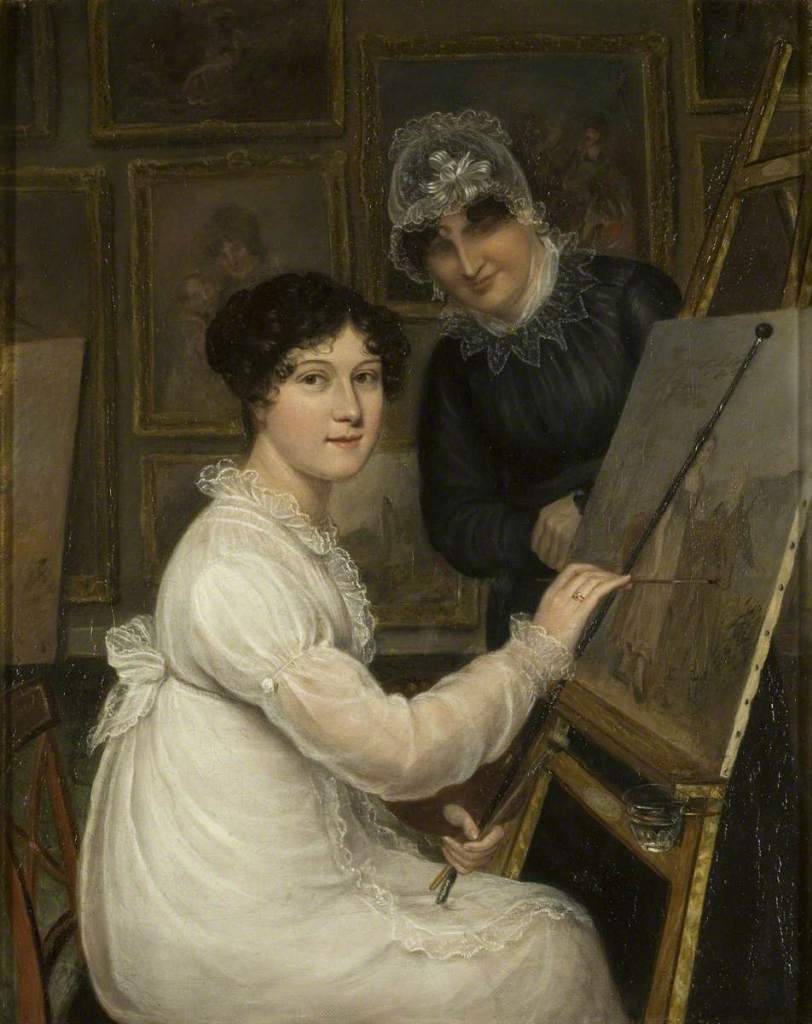
Other paintings from the artist’s gallery include- Self Portrait, Artist and her Mother, Madame Catalini.
Final Words.
Rolinda Sharples was one of the terrific painters from Britain that the state never met again. It is a proud moment for all the art nerds like me to see such a painter who received every honor due to her art and is still in our hearts through her incontestably fine work.
Resources.
- Women Artists: Recognition and Reappraisal from the Early Middle Ages to the Twentieth Century by Karen Petersen, J. J. Wilson.
- Dictionary of Women Artists by Delia Gaze.
Frequently Asked Questions.
Rolinda Sharples was an English painter of the Victorian era who became immensely popular for her portraiture and domestic scenes. Further, she exhibited her art at the Royal Academy making her one of the few female artists to do that and make themselves crucial in history.
Rolinda Sharples was a Neoclassicist who used watercolors, oils, and pastels and depicted sentimental genre art through domestic scenes and portraitures.
Rolinda Sharples died of Breast Cancer in 1838, aged 45 years.
Related Reads.


